MDF Doors with Flat Surfaces and Precise Profiles
- Raised wood grain will not show through solid-colour finishes
- CNC groove depths are easier to keep consistent
- Edges are less likely to chip during detailed machining
- Decorative surface materials and paint can be applied more evenly
- Door leaves are easier to keep consistent in appearance during batch production
How Wanbaoyijia MDF Doors Are Constructed
The MDF doors on this page are interior doors that use MDF panels on both sides of the door leaf. This does not mean that the entire door leaf is made from solid MDF.
The MDF panels are pressed together with a solid wood perimeter frame and an internal door core. The core can be filled with honeycomb paper, tubular particleboard, particleboard, solid wood strips or other materials.
A standard door leaf is 50 mm thick and weighs 30–40 kg. The architrave is 70 mm wide and is made from plywood or solid wood.
You can send the door dimensions and structural requirements to Wanbaoyijia, and we will recommend a suitable MDF door configuration.
MDF Door Options by Surface Finish
The main difference between these MDF doors is the surface material applied to the MDF face panel. You can select the finish according to the required appearance, door design, cleaning requirements and project budget.

The MDF panel is covered with a melamine finish. It is mainly used for flat door designs and is available in solid colours, wood grains and other decorative patterns.

The MDF surface is sanded and finished with paint. It can be produced as a flat door or CNC-routed with grooves and patterns, with matt, semi-gloss and high-gloss finishes available.

Natural or engineered wood veneer is pressed onto the MDF panel and then finished with paint or a clear coating. It provides a wood-grain appearance while retaining the flat MDF base.
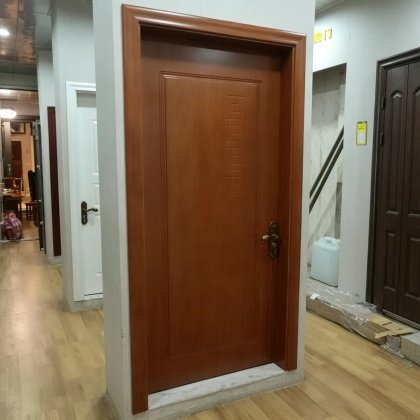
The MDF panel is CNC-routed before PVC film is applied by vacuum pressing. The film follows the grooves and shaped areas, making this option suitable for doors with routed patterns.

PET film is laminated onto the MDF panel. This finish is mainly used for flat door designs and is available for selected matt, high-gloss and plain-colour finishes.

A wood-grain or decorative pattern is transferred onto the MDF surface using heat-transfer film.
MDF Door Solutions for Consistent Project Specifications
Before production, Wanbaoyijia checks each MDF door specification against the approved drawings and samples, helping you reduce configuration errors and keep the different door types in your order clearly organised.

We confirm the MDF panel thickness according to your door design and application, helping you avoid a mismatch between the panel and surface finish.

You can confirm the colour, texture, gloss level and wood-grain direction before production, reducing differences between the approved sample and the finished doors.

You can select the door core according to the required weight, strength, sound insulation and budget.

We confirm the edge-sealing method for your selected panel and finish, helping reduce moisture absorption through exposed MDF edges.

You can provide the door closer, viewer and other hardware requirements before production, so solid wood reinforcement is added at the correct positions.

The door leaf and frame are painted together, helping you keep the colour consistent across the complete door set.

Before mass production, we can provide a colour sample, structural section sample or complete sample door for you to confirm the materials, structure and surface finish.

We can mark the room number, opening direction and package number, helping your site team identify each door during installation.
More Options for Your MDF Door Order
Wanbaoyijia provides MDF doors in different colour ranges, door leaf thicknesses and packaging methods, allowing you to choose according to your project requirements.

More than 100 solid colours are available, making it easier to match different rooms with their interior styles within the same project.

You can select the door leaf thickness according to the door size, required weight, strength and sound insulation.

Paper wrapping and foam protection can be selected according to the shipping method, helping you control packaging costs and reduce product damage.

More than 50 paint colours are available, making it easier to match the doors with walls, furniture and other interior finishes.

Different MDF door finishes can be supplied within the same project, so you can place them under one order instead of sourcing each finish from a separate supplier.

Wanbaoyijia has 15 years of experience in wooden door production and can help you confirm specifications, solve installation questions, and arrange replacement parts when required.
Balanced Pressing for a More Stable MDF Door Leaf
Wanbaoyijia uses MDF panels of the same thickness on both sides of the door leaf to keep the structure balanced. Adhesive is applied with a glue-spreading machine, creating a more even glue layer than manual application and reducing uneven stress that may cause the door leaf to warp.
A homogeneous core board is used to provide even support beneath the MDF panels, helping you obtain a flatter door surface with less risk of the internal structure showing through. After pressing, each door leaf is kept flat for 24 hours before moving to the next production stage. This allows the adhesive layer and door structure to stabilise, helping the door leaf maintain its shape during later processing, transportation and installation.


Finished-Door Testing, Not Just Panel Reports
An MDF panel report only shows the test results of the board itself. To provide you with more information about the completed product, a finished carbon crystal wooden door supplied by our production system was submitted for testing according to WB/T 1024-2006.
The tested sample recorded a formaldehyde release of 0.3 mg/L against the E1 limit of 1.5 mg/L. The same report recorded a surface flatness of 0.80 mm, warpage of 1.30 mm and moisture content of 8.4%, with the tested items judged compliant.
This allows you to review the formaldehyde test result together with the flatness, warpage and surface condition of the finished door, instead of relying only on an MDF panel report. The complete test report can be provided for project review when required. The results apply to the sample submitted for this commissioned inspection.
Helping You Prepare for an MDF Door Order

Download a checklist for recording door sizes, quantities, opening directions, frame details and required delivery dates before sending your enquiry.

Use the measurement sheet to record the hinge, lock, backset, door closer and access-control details required for factory machining.

Use the form to check package numbers, quantities, opening directions, surface condition and transport damage when the doors arrive.
One-Stop MDF Door Supply from 20+ Factories


Wanbaoyijia manages more than 20 interior door factories. For large MDF door orders, production can be coordinated across several production lines according to the same approved sample, drawings and quality requirements. This allows us to provide the required production capacity and helps shorten your delivery time while keeping the product specifications consistent.
One production plan can cover door leaves, frames, hardware machining, project marking, packaging and delivery batches, reducing the time you spend coordinating each part of a large order.
MDF Door Solutions for Different Project Requirements
Wanbaoyijia has supplied MDF doors with different surface finishes, colours and panel structures based on the budget, design and delivery requirements of each project. The following cases show how we selected suitable MDF door solutions for different applications.

For a project in Egypt, the client required a cost-effective product and a short delivery time. We recommended moulded MDF doors. The door design is formed in one pressing process, and the delivery time is only 12–15 days. More than 100 designs and colours are available. After reviewing the proposal, the client approved the solution.

One of our Chinese clients needed doors in 15 colours for one project, but melamine-faced panels were not available in enough solid colours. We recommended solid-colour painted MDF doors with 6 mm MDF face panels. This solution met the project’s requirement for multiple colours.

For a kindergarten project, the client required three colours on one door leaf together with glass. We recommended painted MDF doors. By applying a second round of paint manually, we can produce more than two colours on one door leaf. The client accepted our suggestion and placed an order for 37 sets of MDF doors.

For a project in Saudi Arabia, the client sent us a photo of a solid sapele wood door and wanted a similar appearance at a lower cost. We recommended a door with a 6 mm MDF face panel, sapele veneer, and a painted finish. The total cost was only one-third of the cost of a solid sapele wood door, while the veneered MDF door still had a similar appearance. The client was satisfied with the solution.
MDF Door Factory Visits
Visitors see the production area and finished doors during the factory tour.
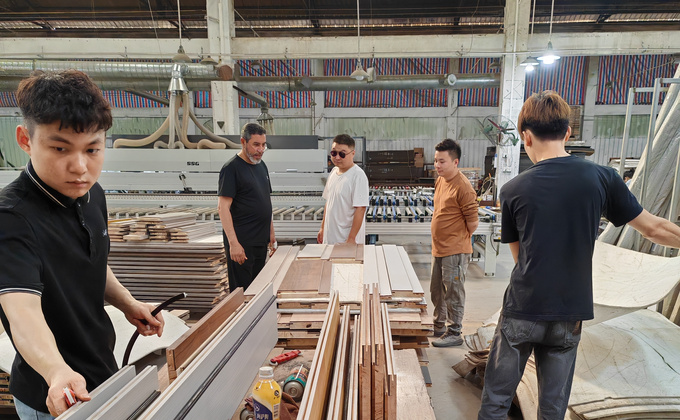
Customers stand beside a worktable and look at stacked door components.

Visitors look at a large panel surface with our team in the workshop.

MDF Door Buying Guide for Project Buyers
Helping you decide whether an MDF door is suitable for the intended room, compare quotations based on the same door structure, check moisture exposure and site-trimming limits, and confirm what should be approved before mass production.
- Product Specifications
- After-Sales Service
- Product Details
The MDF panel thickness, door leaf structure, internal filling, surface finish, frame and hardware preparation can be customised according to your drawings, project requirements and budget.
Item | Specification | Item | Specification |
Door Type | MDF Interior Door | Door Configuration | Single Door / Double Door / Unequal Double Door |
Reference Door Set Size | 2100 × 900 × 160 mm | Size Customisation | Available According to Drawings |
Door Leaf Thickness | 45 / 50 / 55 mm | Standard Door Leaf Weight | About 30–40 kg for a 50 mm Door Leaf |
Face Panel Material | MDF / HDF | MDF Panel Thickness | 4 / 6 / 8 mm |
Door Leaf Structure | MDF Face Panels + Perimeter Frame + Internal Core | Perimeter Frame | Solid Wood / LVL |
Door Core | Honeycomb Paper / Tubular Particleboard / Particleboard / Solid Wood Strips | Supply Form | Door Leaf / Door and Frame / Complete Door Set |
Surface Finish | Melamine / Paint / Veneer / PVC / PET / Heat Transfer | Door Design | Flat / CNC-Routed / Moulded |
Melamine Colours | 100+ Options | Paint Colours | 50+ Options |
Paint Finish | Matt / Semi-Gloss / High-Gloss | Veneer Options | Natural Veneer / Engineered Veneer |
Door Frame Material | Plywood / Solid Wood | Architrave Width | About 70 mm / Customisable |
Edge Treatment | PUR Edge Banding / Solid Wood Edging / Painted Edge Sealing | Moisture Protection | Exposed Edges and Site-Cut Areas Should Be Sealed |
Hardware Preparation | Lock and Hinge Positions Can Be Pre-Machined | Hardware Reinforcement | Solid Wood Reinforcement for Hinges, Locks, Closers and Viewers |
Optional Glass | Clear / Frosted / Fluted / Patterned Glass | Opening Direction | Inward / Outward / Left-Hand / Right-Hand |
Sample Confirmation | Colour Sample / Structure Sample / Complete Sample Door | Project Marking | Room Number / Opening Number / Opening Direction |
Packaging | Paper Wrapping / Foam Protection | Delivery Time | 12–25 Days, Depending on Structure and Finish |
Application | Apartment / Hotel / School / Office / Residential Projects |
- If you find damaged corners, surface scratches, edge swelling, loose veneer or PVC film, colour differences, door leaf warping or incorrect hardware positions after receiving the MDF doors, please provide photos, videos, package numbers and order details. Wanbaoyijia will check whether the issue is related to transport, storage, site cutting, moisture exposure, surface bonding or production, and provide repair materials, matching edge bands, touch-up paint, replacement panels, hardware parts or replacement door leaves according to the situation.
- For additional orders, please provide the original order number, drawings or approved samples. We will check the MDF panel thickness, door leaf structure, surface finish, colour code, CNC pattern, frame specification and hardware positions according to the original production records, helping reduce differences between the new doors and those already installed.
View the MDF face panels, door leaf edge treatment, internal frame and filling, hardware reinforcement, CNC-routed grooves, surface finish, lock and hinge machining, and finished door appearance.


Trusted MDF Doors for Global Projects
The Lock Holes Were Accurately Machined
I ordered 103 sets of MDF doors and asked them to machine all the lock holes before delivery. I checked with our installers, and they said the lock holes were accurate. This also saved a lot of time during installation.
 Tarek AbdelrahmanInterior Door Installation Contractor | Egypt
The Paint Finish Was Well Done
The MDF doors for our hotel project used a painted finish. The paint was applied evenly, and the gloss level was well controlled. You could see that their workers were skilled.
 Liang WenjieHotel Project Manager | China
Their MDF Doors Saved Me a Lot of Money
My original plan was to use 8 mm solid wood panels for the carved design. They suggested that 8 mm MDF panels could also be used, so I followed their advice. The MDF doors with 8 mm face panels turned out well and saved me a lot of money.
 Majed Al-OtaibiBuilding Contractor | Saudi Arabia
Not necessarily. MDF has a uniform surface without the knots or raised grain found in natural wood, making it suitable for painted doors. However, the term “MDF door” only describes the material used for the door leaf face panels. The panel thickness, internal filling, perimeter frame, edge sealing and surface finish still affect the quality of the complete door.
When comparing MDF doors with solid wood doors, you should compare the complete door structure and intended application rather than judging them only by the material name.
The MDF panel thickness, internal filling, frame material, surface finish and hardware reinforcement may differ. Before comparing prices, ask each supplier to quote according to the same product specifications or provide a door leaf section sample. This helps you avoid choosing an apparently lower price when the actual door structures are different.
It is better not to trim an MDF door on site. If trimming is necessary, you should first confirm the permitted trimming allowance with the manufacturer. Any MDF exposed after cutting or drilling must be sealed again to reduce moisture absorption. Major size adjustments should be completed at the factory rather than on site.
Paint cracking is not caused simply by the use of MDF. It may occur if the cut MDF edges are not properly sealed, if the primer and topcoat do not bond correctly, or if there is slight movement at the joints between different components. Under normal use, paint cracking rarely occurs on our MDF doors.
The MDF face panels alone do not determine the sound insulation of a wooden door. The internal filling, door leaf thickness, weight, perimeter sealing, bottom gap and installation quality all affect sound transmission.
For hotel rooms, offices or bedrooms, the door core and sealing structure should be selected according to the sound insulation requirements. If the project requires a specific acoustic rating, the test result should apply to the complete door set rather than only to the MDF panel.
An MDF door usually refers to a door leaf with MDF face panels, while a solid core door refers to a door leaf with solid internal filling. Therefore, an MDF door can also have a solid core. The solid core may use particleboard, engineered wood, solid wood blocks or other high-density filling materials. It does not mean that the entire door is made of solid wood.
A solid core is worth considering for hotel rooms, bedrooms, offices and other areas that require a heavier door leaf, stronger hardware support or better sound control. If the project mainly requires a lower price and a lighter door leaf, honeycomb paper or another lightweight core may be sufficient.
Related Products

Carbon crystal doors offer customizable colors, finishes and designs for bulk hotel, apartment, residential and commercial projects.

Plywood door sets combine plywood-faced leaves and matching frames with selectable semi-solid or solid-core structures.

Engineered wood doors use plywood faces and engineered timber construction for improved stability and moisture resistance.

Finger-jointed rubberwood solid wood doors provide substantial construction with natural texture and reduced warping risk.

Solid core doors provide stable, durable construction with selectable finishes for hotels, apartments, offices and residential projects.

Lightweight honeycomb doors help project buyers balance door weight, installation handling and cost-controlled specifications.