Professional Semi-Solid Core Door Manufacturer
- Tubular or cross-slotted cores help maintain door leaf flatness and stability.
- The internal cavities help reduce the weight of the door leaf.
- Tubular particleboard cores offer good dimensional consistency and are suitable for hotel projects.
- Solid timber cores provide customers with a higher-grade material option.
- Different core grades can be specified for different rooms within the same project.
Why Do Semi-Solid Core Door Quotations Vary So Much?
- See how particleboard, solid timber and 3D core structures affect the price.
- Learn which hidden specifications can make two similar-looking doors different.
- Understand why the lowest quotation often changes after the final requirements are confirmed.
- Find out why a more expensive core does not always provide better sound insulation.
- Use the quotation checklist to compare suppliers based on the same specifications and total project cost.

Wanbaoyijia — Professional Semi-Solid Core Door Manufacturing Capabilities
Wanbaoyijia’s semi-solid core door leaf is 50 mm thick and consists of two 4 mm face panels and a 42 mm semi-solid core, giving you a more substantial door leaf.
The tubular particleboard core has 30 mm-diameter holes, with 8 mm of material retained between adjacent holes, improving the stability of your door leaf.
The 3D cross-slotted solid timber core is 42 mm thick, with 5 mm-wide slots positioned at a 45-degree angle to the face panels. The multidirectional slots form a more complex internal structure, effectively reducing noise transmission and improving the sound insulation of your door leaf.
Send us your semi-solid core door requirements and receive a bespoke solution within 24 hours.
Semi-Solid Core Doors by Core Structure
Our semi-solid core doors are available with six core structures to suit different budgets, material preferences and project requirements.
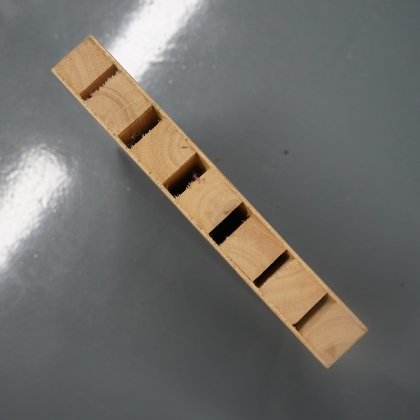
Solid timber blocks are arranged with reduced spacing to increase the core density and provide more support behind the face panels. Suitable for projects requiring a stronger structure than a standard hollow core.
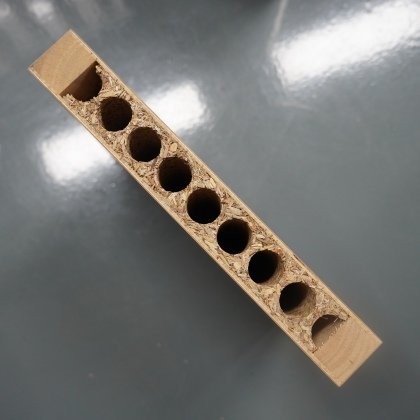
Regular tubular cavities provide good dimensional consistency and door leaf flatness. Suitable for hotel, apartment and other large-volume projects.
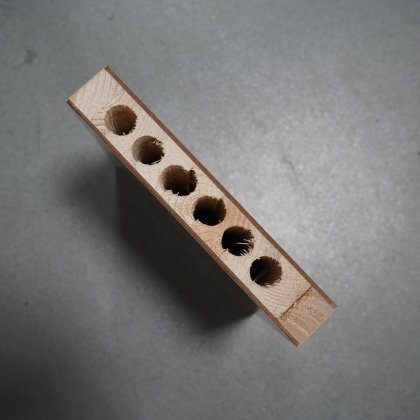
Round cavities are machined into solid timber, providing a higher-grade material option while retaining the tubular core structure. Suitable for private residences and projects that prefer solid timber.

Internal cavities are arranged alternately on both sides of the solid timber core. This structure increases the number of internal cavities while retaining continuous timber between adjacent openings.
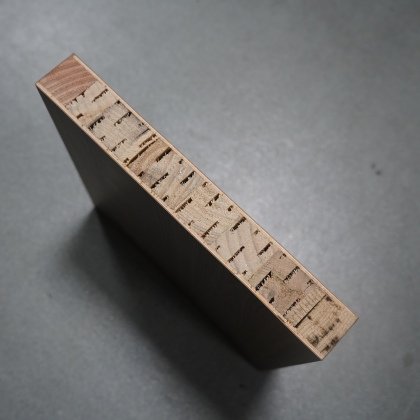
Staggered grooves are cut into both sides of the solid timber core along the height of the door leaf. The grooves help distribute lateral timber movement and reduce the risk of cross-sectional cupping.

Solid timber strips are cut with multidirectional slots and reinforced with plywood between the strips and on both outer sides. The more complex core structure is suitable for villas and high-end residential projects.
Why Choose Our Semi-Solid Core Door Solutions
Wanbaoyijia controls the key production stages of each semi-solid core door, from core material selection to final inspection, helping you obtain door leaves that are more stable, durable and consistent across large-volume orders.

Before production, we check the density of the particleboard and the moisture content of the solid timber core to reduce the risk of loose core material and deformation over time.

After the core has been processed, its thickness is checked again to reduce the risk of an uneven door leaf.

The hole diameters and slot dimensions are carefully checked to ensure that the core structure meets the design requirements while retaining sufficient internal support.

Panels of the same thickness are used on both sides of the core to reduce uneven stress and lower the risk of door leaf deformation.

Sufficient solid material is retained around the lock installation area to provide reliable support for the lock body and door handle.

The hinge quantity and specifications are selected according to the door leaf weight, reducing the risk of loose hinges and door leaf sagging after long-term use.

The pressure and pressing time are adjusted according to the core structure to improve the bond strength between the core and the face panels.

Each door leaf is checked for flatness before packing to reduce the risk of defective products reaching the project site and lower rework costs.
Structural Advantages of Semi-Solid Core Doors
The semi-solid core supports the door panels and hardware installation areas, reducing local dents and hardware loosening while providing a feel similar to a solid-core door and keeping the door leaf weight under control.

The door panel is less likely to develop local dents or damage when it is hit or compressed.

The core provides support for locks, handles and other hardware.

The door does not produce an obvious hollow sound when it is closed or knocked on.

Compared with a fully solid core, the door leaf can be made thicker without reaching the same weight.

Provides more even support for the door panels, helping the door leaf surface remain flat.

Suitable for projects that need to balance budget, weight and performance.
3D Cross-Slotted Solid Timber Core Reinforcement
The 3D cross-slotted solid timber core uses timber strips with a cross-section of approximately 42 mm × 42 mm. Multiple slots are cut into each strip at a 45-degree angle to form multidirectional internal cavities.
To prevent the strength of a single timber strip from decreasing after slotting, five processed timber strips are laid side by side. A 2 mm plywood sheet is placed between each pair of strips, with adhesive applied to both sides. The five timber strips are then pressed together to form a complete core panel. A 6 mm plywood sheet is added to each outer side, creating a reinforced structure of “6 mm plywood + timber strip + 2 mm plywood + timber strip.”
The plywood connections and outer reinforcement compensate for the strength lost during slotting. This allows the core to retain its overall strength and stability while containing multiple internal cavities. The multidirectional slots also lengthen the sound transmission path through the core, helping reduce noise transmission and improve the sound insulation of the semi-solid core door.


Reducing Door Leaf Deformation with Staggered Grooves
To disperse the internal stress in the timber, grooves are cut into both sides of the solid timber core along the height of the door leaf. The grooves are 5 mm wide, with 30 mm-deep grooves on one side and 5 mm-deep grooves on the other. After grooving, the previously continuous timber section is divided into several narrower support sections, allowing the stress caused by lateral shrinkage and expansion to be distributed across different areas and helping reduce the risk of cross-sectional deformation in your door leaf.
The double-sided staggered grooves reduce lateral stress concentration while retaining the structural connection of the core. The core is then laminated with 4 mm panels on both sides to further balance the stress across the door leaf, helping your semi-solid core door maintain better flatness and stability.
Semi-Solid Core Door Resources

View our six semi-solid core structures and their recommended applications for hotels, apartments, private residences and villas.

See the actual core samples and compare their materials, cavity structures and suitable project types.

Understand how core material, cavity design, door leaf thickness and room use affect your choice of semi-solid core door.
Semi-Solid Core Door Selection & Cost Solution

Wanbaoyijia offers six semi-solid core structures. As we are not limited to a single core structure, we can recommend a suitable option based on your room use, project budget and sound insulation requirements. Within the same hotel or apartment project, standard rooms can use tubular particleboard cores, while suites, master bedrooms and other important areas can use tubular solid timber cores or 3D cross-slotted solid timber cores.
Before production, we can provide core samples or cross-sectional photos and confirm the door leaf thickness, panel thickness and hardware reinforcement positions. This helps you control the overall project cost while using higher-grade cores only where they are needed.
Semi-Solid Core Selection for Different Projects
We select different semi-solid core structures for our clients based on room use, material preference, sound insulation requirements and project budget.

For a project in Yemen, the client had a limited budget but wanted performance close to that of a solid-core door. We recommended a close-spaced solid timber core. This filling method is simple, and the core is made entirely of solid timber, providing high resistance to deformation. The client accepted our proposal and ordered 57 semi-solid core doors.

An Egyptian client wanted semi-solid core doors with better flatness and sound insulation than standard hollow-core doors, but the project budget was not sufficient for solid timber cores. We therefore recommended tubular particleboard cores for the semi-solid core doors. Door leaves filled with tubular particleboard cores offer good flatness and better sound insulation than standard hollow-core doors. The client accepted our proposal and ordered 72 sets of semi-solid core doors with tubular particleboard cores.

For a private residence project in Hong Kong, the client liked the tubular core structure and considered it good for sound insulation, but did not want to use particleboard. We therefore recommended semi-solid core doors with tubular solid timber cores. Compared with particleboard cores, tubular solid timber cores use less adhesive and are more environmentally friendly. The client finally ordered 21 sets of semi-solid core doors with tubular solid timber cores.

For a villa project in Saudi Arabia, the client needed wooden doors that were relatively light and provided sound insulation. We therefore recommended 55 mm-thick semi-solid core doors filled with 3D cross-slotted solid timber cores. Although the door leaves were 55 mm thick, they were not too heavy. The semi-solid core doors have now been in use for one year, and the client is satisfied with them.
Semi-Solid Core Door Factory Visits
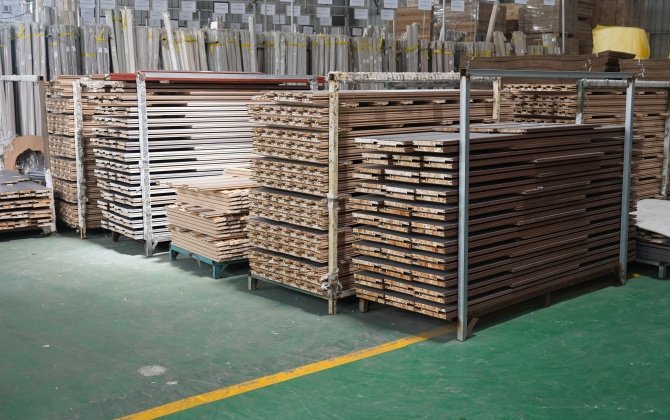
Customers visit our factory to see the workshop and how we make doors.

A visitor bends down to inspect material beside stacked panels in the workshop.
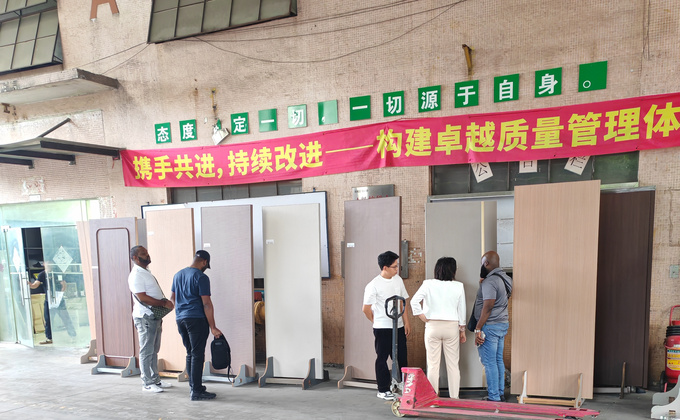
Visitors look at several full-size door samples displayed inside the workshop.

Semi-Solid Core Door Guide
Helping you understand core construction, door leaf specifications, hardware reinforcement and ordering requirements.
- Product Specifications
- After-Sales Service
- Product Details
All sizes, core structures, finishes and hardware configurations can be customised according to your project requirements, room use and budget.
Item | Specification | Item | Specification |
Door Type | Semi-Solid Core Door | Standard Door Leaf Thickness | 50 mm |
Face Panel Thickness | 4 mm on each side | Core Thickness | 42 mm |
Core Material | Particleboard / Solid Timber | Core Structure | Tubular / Grooved / Cross-Slotted |
Core Options | Six core structures available | Door Leaf Thickness Options | 50 / 55 mm |
Standard Size | 2100 mm (H) × 900 mm (W) | Size Customisation | Available |
Door Frame Material | Solid Wood / Plywood | Hardware Reinforcement | Lock and hinge areas reinforced |
Hinge Quantity | 3–4 Hinges | Lock & Handle | Optional |
Surface Finish | Painted / Veneer / Melamine | Opening Direction | Inward / Outward |
Edge Structure | Square Edge / Rebated Edge | Sealing Strip | Optional |
Transport Protection | Wooden Battens / Wooden Crate Optional | Application | Hotel / Apartment / Villa / Residential Projects |
- For each semi-solid core door order, we retain the approved core specifications and production records, including the core material, cavity structure, core thickness and reference door leaf weight. If you find that the delivered core does not match the approved sample or specifications, please provide cross-sectional photos or other relevant information. We will compare them with the retained records and provide a solution based on the inspection results.
- If abnormal cupping or deformation occurs after installation and is confirmed to have been caused by core processing or panel pressing, we will provide repair guidance or arrange a replacement according to the specific circumstances.
View real product details, core structures, core materials and finished door effects.


Semi-Solid Core Doors Trusted by Clients Across Different Projects
More Than 100 Doors Completed in 19 Days
I originally thought semi-solid core doors would take longer to produce than hollow-core doors, but the lead time was still very fast. They completed more than 100 doors in 19 days. I think they work very efficiently.
 Ahmed HassanEgyptian Hotel Project Contractor
The 1.2 m-Wide Door Leaf Did Not Deform
They are very professional when it comes to door core construction. They recommend suitable core structures for different projects and consider details that we may not have thought of. For example, I needed a 1.2 m-wide door leaf, and they recommended a Stress-Relief Grooved Solid Timber Core. I thought their suggestion made sense, and the finished door leaf did not deform.
 Raymond ChanHong Kong Residential Project Client
Their Wooden Doors Are Trustworthy
They are trustworthy. During installation, three semi-solid core door leaves were accidentally damaged, so we cut them open on site to check whether the internal cores met our requirements. We found that all three door leaves had been filled according to the agreed specifications.
 Faisal Al-HarbiSaudi Villa Project Contractor
Whether minor trimming is possible depends on the width of the solid timber retained around the perimeter of the door leaf. Excessive trimming may expose the internal cavities or affect the reinforced lock and hinge areas. We therefore recommend confirming the final door leaf size, lock position and hinge positions before production.
The choice depends on the room use, project budget, material preference and sound insulation requirements. Tubular particleboard cores are suitable for standard hotel rooms and large-volume projects. Tubular solid timber cores are suitable for residential projects that prefer solid timber, while 3D cross-slotted solid timber cores are mainly used for villas, suites and rooms with higher requirements.
Yes. The denser internal structure and designed cavities help reduce sound transmission through the door leaf. However, the final sound insulation performance also depends on the door leaf thickness, door frame, seals, door gaps and installation quality.
When the core is properly designed and reinforced, the holes do not remove the support required by the door leaf. For example, plywood is placed between the slotted timber strips in our 3D cross-slotted solid timber core, with thicker plywood added to both sides of the core for reinforcement. Solid material is also retained around the lock and hinge areas, allowing the core to contain multiple cavities while still supporting the face panels and hardware.
Semi-solid core doors are not automatically fire-rated. “Semi-solid core” describes the internal construction of the door leaf, rather than its fire performance. A fire-rated door must be tested and certified as a complete doorset, including the door leaf, frame, hardware and other related components.
Related Products

Lightweight hollow core doors support cost-conscious apartments, rentals, hotels and large interior fit-out projects.

Lightweight honeycomb doors help project buyers balance door weight, installation handling and cost-controlled specifications.

Louver doors provide airflow, privacy and customizable material or opening options for varied interior requirements.

Solid rubberwood stile and rail doors offer customizable panel layouts, painted finishes and stable interlocking construction.

Engineered hotel doors combine durable finishes with configurable cores for sound control, stability and repeated project use.

Acoustic doors combine configurable leaf thicknesses and filling methods to balance sound control with project budgets.